Work today moves across devices, networks, and locations. Your team logs in from home, cafés, shared offices, and sometimes unsecured WiFi. Everything still needs to work fast and stay protected.
That is where vpn solutions for business quietly become the backbone of daily operations. Not as a feature, but as a necessity.
Still, most businesses either overcomplicate it or choose tools that were never built for teams. The result shows up later as slow connections, access issues, or security gaps.
This guide breaks it down in a practical way. You will see what works, what does not, and how to choose a VPN solution that fits your business without wasting time or budget.
What Is a VPN Solution for Business
A VPN solution for business is a secure system that allows employees and teams to access company resources safely over the internet. It encrypts data and controls user access based on roles and permissions.
Unlike personal VPNs, business VPNs focus on managing users, protecting internal tools, and maintaining secure operations across devices.
Why VPN Solutions for Business Matters
Teams are no longer tied to one network. That flexibility creates exposure.
A structured VPN solution helps control who connects, what they access, and how data moves.
Here is where businesses actually use it:
- Remote employees accessing internal dashboards
- Teams working on public or shared networks
- Vendors needing limited system access
- Businesses handling sensitive client data
According to IBM, the average cost of a data breach reached $4.45 million globally. Most issues begin with weak access control, not advanced attacks.
That is why a proper VPN setup is not just IT support. It is risk control.
Best VPN Solutions for Business (Based on Use Case)
Choosing becomes easier when you match the solution to how your business works.
For small teams
Remote access VPN works best. It is simple, affordable, and easy to manage.
For growing businesses
Cloud-based VPN offers flexibility and better scalability as teams expand.
For large companies
Site-to-site VPN connects multiple offices into one secure network.
For businesses launching their own VPN
White-label VPN solutions provide a ready system with branding and infrastructure handled.
This is where many businesses save months of development time.
Types of VPN Solutions for Business
Each type solves a different problem. Understanding this avoids costly mistakes later.
Remote Access VPN
Employees connect securely from anywhere.
Best for:
- startups
- remote teams
- small businesses
Site-to-Site VPN
Connects multiple office networks into one system.
Best for:
- enterprises
- companies with physical branches
Clientless SSL VPN
Access happens through a browser. No installation needed.
Best for:
- third-party vendors
- temporary access
- BYOD environments
Cloud VPN
Designed for modern cloud-based operations.
Best for:
- SaaS companies
- distributed teams
- fast-growing startups
Quick Comparison
| Type | Setup | Best For | Flexibility |
| Remote Access | Easy | Small teams | Medium |
| Site-to-Site | Complex | Enterprises | High |
| Clientless VPN | Easy | Vendors | Medium |
| Cloud VPN | Moderate | Growing teams | High |
VPN Solutions for Small Business vs Large Business
Not all VPN solutions fit every business. This is where clarity matters.
VPN solutions for small business
Small teams need simplicity.
Focus on:
- quick setup
- low cost
- minimal maintenance
- easy user control
A lightweight or vpn solution for small business works best when it avoids unnecessary complexity.
VPN solutions for large business
Large businesses need structure and control.
Focus on:
- advanced user management
- global access
- compliance
- system integration
This is where infrastructure matters more than speed of setup.
What to Look for in a VPN Solutions Provider
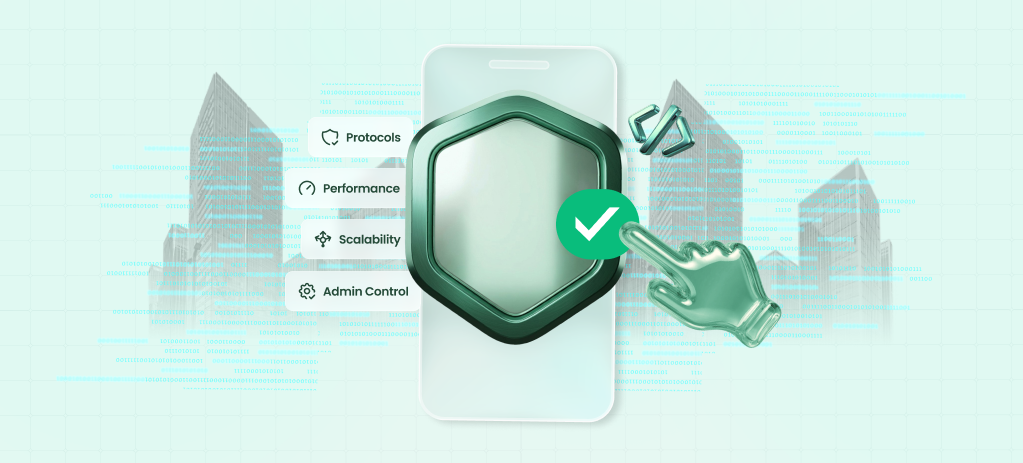
Choosing the right VPN solutions provider can prevent long-term performance and security issues. The goal is not just to connect users, but to ensure reliable and controlled access across your business.
Focus on the factors that directly impact real usage:
- Performance: A slow VPN disrupts workflows and reduces productivity. Test connection speed across different locations and peak usage times.
- Admin control: You should be able to manage users, roles, and permissions without complexity. A clear admin panel makes daily operations easier and more secure.
- Scalability: Your VPN should support growth. It must handle more users, devices, and locations without performance drops.
- White-label capability: This is essential if you plan to launch your own VPN service. It allows you to build a branded product without managing infrastructure.
👉 If that is your goal, a structured VPN app development solution can help you launch faster with full control over your product.
- Support and maintenance
Reliable support becomes critical when your business depends on continuous access. Look for providers that offer ongoing updates, monitoring, and technical assistance.
How Businesses Actually Choose a VPN
Most confusion clears up when the decision is simplified. Instead of comparing every feature, you should match the VPN to how your business operates:
- Small team with remote access → Remote access VPN
- Growing company with expanding users → Cloud-based VPN
- Multi-location business → Site-to-site VPN
- Planning to launch a VPN product → White-label VPN solution
Think beyond immediate needs. Switching systems later often costs more than choosing the right setup from the start.
What Actually Impacts VPN Performance and Security
A VPN is not just about connecting users. Its performance and reliability depend on how the system is built, configured, and managed over time.
Protocols
The protocol you choose directly affects speed, stability, and accessibility.
- WireGuard → fast, lightweight, and efficient for modern use
- OpenVPN → stable, secure, and widely supported across platforms
- Trojan protocol → performs well in restricted networks and bypasses filtering
The right protocol helps maintain consistent performance across different environments and network conditions.
Why is a VPN alone not enough?
A VPN secures the connection, but it does not cover everything.
To maintain real security, businesses also need:
- clear access control policies
- monitoring and logging systems
- proper user and role management
Ignoring these areas often leads to issues, even when a VPN is active. Security gaps usually come from mismanagement, not the VPN itself.
Common Mistakes Businesses Make
These mistakes show up often and usually cost more over time:
- Choosing the cheapest VPN without thinking about scalability
- Ignoring admin controls and user management features
- Using personal VPN tools for business operations
- Overbuilding complex systems for small teams
- Not planning for future growth and expansion
Each of these decisions creates friction later. It either slows down your team or forces you to rebuild everything again.
A VPN becomes part of your daily workflow. It should run quietly in the background, not interrupt how your business operates.
How Much Does a VPN Solution for Business Cost
The cost of a VPN solution for business depends on setup, features, and long-term scalability.
| Setup Type | Estimated Cost | What’s Included |
| Basic Setup | $1,000 – $3,000 | Core features, simple deployment, limited customization |
| Advanced Setup | $3,000 – $8,000+ | Scalable infrastructure, advanced features, better control |
| Ongoing Costs | Varies | Server maintenance, updates, technical support |
The global VPN market is expected to reach $137 billion by 2030, reflecting the growing demand for secure business connectivity.
👉 For a detailed cost breakdown based on your business needs, you can explore pricing or connect directly for a tailored estimate.
What Is the Best VPN Solution for Business
The best VPN solution for business depends on how your team works and how your company plans to grow.
- Small teams usually do well with a remote access VPN. It is simple to set up and easy to manage.
- Growing businesses need more flexibility. A cloud-based VPN helps scale users, devices, and locations without adding complexity.
- Large organizations rely on site-to-site VPNs. These connect multiple offices into one secure network with full control.
If your goal is to launch your own VPN service, a white-label VPN solution is the best choice to think of . It gives you a ready-made system with branding, infrastructure, and faster time to market.
FAQ
What is the best VPN solution for small businesses?
A remote access VPN works best for small teams. It is easy to set up, affordable, and provides enough control for daily operations.
How much does a business VPN cost?
A basic white label VPN setup can start around $1,500. More advanced solutions can go beyond $5,000 depending on features and scale.
What is the difference between personal and business VPN?
A personal VPN protects individual privacy. A business VPN manages users, controls access, and secures company systems.
Is a white-label VPN solution worth it?
Yes. It allows businesses to launch a VPN product without building infrastructure. It reduces cost and speeds up launch time.
Which VPN protocol is best for business use?
WireGuard and OpenVPN are widely used. Trojan protocol is useful in restricted network environments.
Final Thoughts
Choosing the right vpn solution for business is not about picking the most advanced system. It is about choosing what fits your workflow, your team, and your growth plan.
The right setup ensures work in the background, keeps things secure, and does not interrupt how your team operates.
If your goal goes beyond internal use and moves toward building your own VPN product, the decision becomes bigger. You need infrastructure, scalability, and a system that is ready to launch.
That is where having the right VPN app development partner makes the difference between testing an idea and actually building a business.